I didn't find my way to joy instantaneously, or quickly. I had had multiple experiences during my singing training where I had "fixed" an issue while in my voice lesson with my teacher, and gone back to the practice room and had the "same issue" with whatever we had addressed. It made me feel like an ignorant failure, while others were telling me I was a beautiful singer…What a foundation for imposter syndrome!
When I realized that I disliked singing, I simply doubled down on what I had previously done, because I didn't know any other way. I put the conversation away for almost two decades, even after my teacher at the time told me I was a boring singer and needed to go to acting class…which I did, and it helped a little, but I didn't know what I was doing or why anything worked. I simply did what I was told, because that was the model of voice instruction I received: the teacher told me if I was doing something wrong and what to do to fix it (from a mechanistic/corrective point of view). I also taught my students in that same way, because that was the method I was taught (see James McKinney's 1994 textbook The Diagnosis and Correction of Vocal Faults).
Finally, in 2017 (over twenty years after receiving my Master of Music degree and almost four years after completing my doctorate), I connected with Meribeth Dayme, creator of CoreSinging. She took traditional teaching pedagogy (instructor-led, telling students what to do, when, and how), incorporated her strong background in science, and then brought in a wealth of differing fields, including energetic exploration, creativity, play, and listening and responding to actual student experience. It was a revolutionary experience that incorporated what I would call integrative voice pedagogy (taken after the field of integrative psychology, a systems-level perspective moving to a holistic and interconnected perspective1). She stated that it, "synthesizes performance, technique and therapy into a joyful new way of teaching and learning to sing, including Eastern concepts, Western traditions, quantum mechanics, and recent studies on consciousness.”2
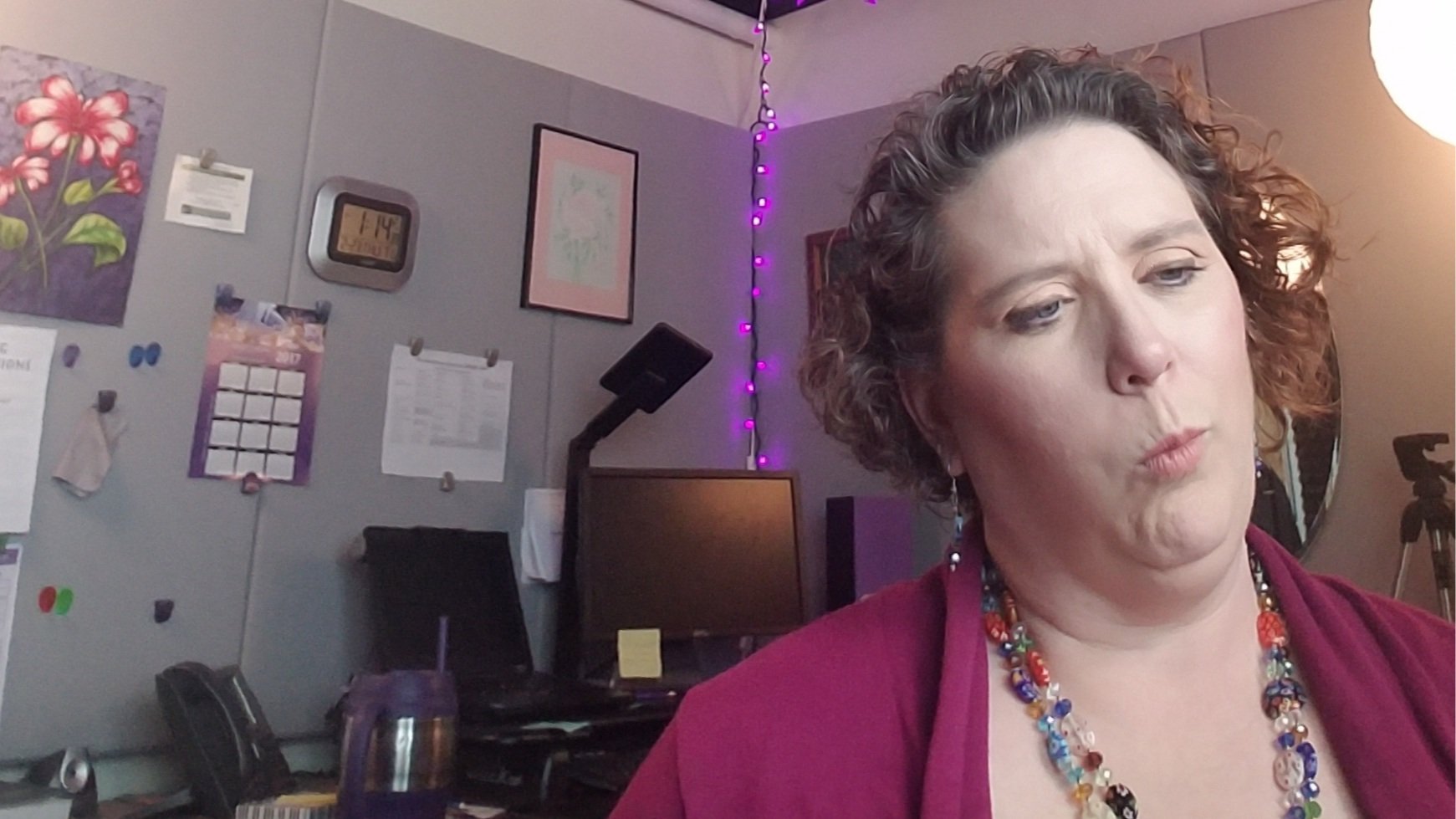
February 2017 during a CoreSinging session. I think I’m doing the classic, “Umm and chew.”
I began reading works on memory, consciousness, how we learn, embodiment, chaos theory, and SO many others. I'll put a short(-ish) list at the end for perusal.
But, these readings, the individual training I did with Meribeth, and my application in my singing teaching brought me to a new way of thinking. I began to sing from a starting point of curiosity and exploration, with a foundational question of What happens if? Rather than trying to get things "right" (and what does that mean, anyway??), I found that I could more readily access a place of willingness and inquiry, without pre-determining a desired outcome. My students began coming in with a clearer understanding of what they desired from their voice lessons, and I began seeing performances that seemed truly authentic to each individual performer, rather than a "beautiful sound singing some kind of text in a variety of languages." They enjoyed singing, and I enjoyed watching their performances. No longer did any of us need to hold our breath and hope for the best.
The next steps on my journey were 1) joining two 12-step programs (DM me for any details you'd like) and, 2) a journey into the world of the Feldenkrais Method, to resolve muscle tension dysphonia. That story next time…
Introductory reading list (starting from Meribeth's list and extending into recommendations from others):
Bertholz, Alain. (2019). Simplexity: Simplifying principles for a complex world. Odile Jacob: New York.
Blake, Amanda. (2018). Your Body is Your Brain: Leverage your somatic intelligence to find purpose, build resilience, deepen relationships, and lead more powerfully. Trokay Press.
Blakeslee, Sandra and Matthew Blakeslee. (2007). The Body Has a Mind of Its Own: How the body maps in your brain help you do (almost) everything better. Random House: New York.
Bowman, Katy. (2017). Move Your DNA: Restore your health through natural movement. Propriometrics Press.
Doidge, Norman. (2007). The Brain that Changes Itself: Stories of personal triumph from the frontiers of brain science. Penguin Books: London.
Feldenkrais, Moshe. (1981, 2019). The Elusive Obvious: The Convergence of movement, neuroplasticity, and health. North Atlantic Books: California.
Feldman Barrett, Lisa. (2017). How Emotions Are Made: The secret life of the Brain. Mariner Books: Boston.
Iwamoto, Taro. (2026). Your Body is Not Broken. Self-published.
Linklater, Kristin. (2006) Freeing the Natural Voice: Imagery and art in the practice of voice and language. Rev. Drama Publishers: Hollywood..
Lipton, Bruce. (2005). The Biology of Belief: Unleashing the power of consciousness, matter, and miracles. Hay House, Inc.: New York.
Lorenz, Edward N. (1993). The Essence of Chaos. University of Washington Press: Seattle.
Nachmanovitch, Stephen. (2019). The Art of Is: Improvising as a way of life. New World Library: California.
Nørretranders, Tor. (1991). The User Illusion: Cutting consciousness down to size. Penguin Books: London. 1998 translation, Jonathan Sydenham.
Ray, Reginald. (2016). The Awakening Body: Somatic meditation for discovering our deepest life. Shambhala Press: Boulder.
Shubin, Neil. (2009).Your Inner Fish: A journey into the 3.5 billion-year history of the human body. Vintage Books: New York.
Waitzkin, Josh. (2007). The Art of Learning: An inner journey to optimal performance. Free Press: New York.
Whitecloud, William. (2009). The Magician's Way: What it really takes to find your treasure. New World Library: California.
Wilber, Ken. (2000). Integral Psychology: Consciousness, spirit, psychology, therapy. Shambala Press: Boulder.
Zander, Rosamund Stone and Benjamin Zander. (2000). The Art of Possibility: Transforming professional and personal life. Penguin Books: London.
Zaring, Aimee. (2026.) Cutting Loose: My Journey from Survival Mode to Embodied Flow, practices for self-regulation and somatic healing. Harper Collins, NY.
1 California Learning Resource Network, "What is integrative psychology?" May 13, 2025. https://www.clrn.org/what-is-integrative-psychology/
2 Cynthia Vaughn, "How I met my mentor: Meribeth (Bunch) Dayme (April 20, 1938-October 28, 2019)," InterNos: Spring 2020. National Association of Teachers of Singing. https://www.nats.org/_Library/Independent_Voices_Articles/Independent_Voices_How_I_Met_My_Mentor_Spring_2020.pdf
